Blogger on the Run aka Jennifer Fisher

If you could see me, you’d notice that I’m blushing! Today, I am being featured as a Blogger on the Run at Women’s Running magazine. Check out the interview and find out all my secrets!  Plus, as a bonus, if you leave a comment today at the bottom of the article (not here), you’ll be entered to win a one-year subscription to Women’ Running magazine.  This monthly magazine is a great resource for female runners, covering all aspects of the running lifestyle, from training plans to the coolest (and cutest) new gear.

If you didn’t win today, come back and get a 20-issue subscription here:

From Flexed-Arm Hang Flunkee to Dead-Hang Pull-Up Diva – Pull Up Tips

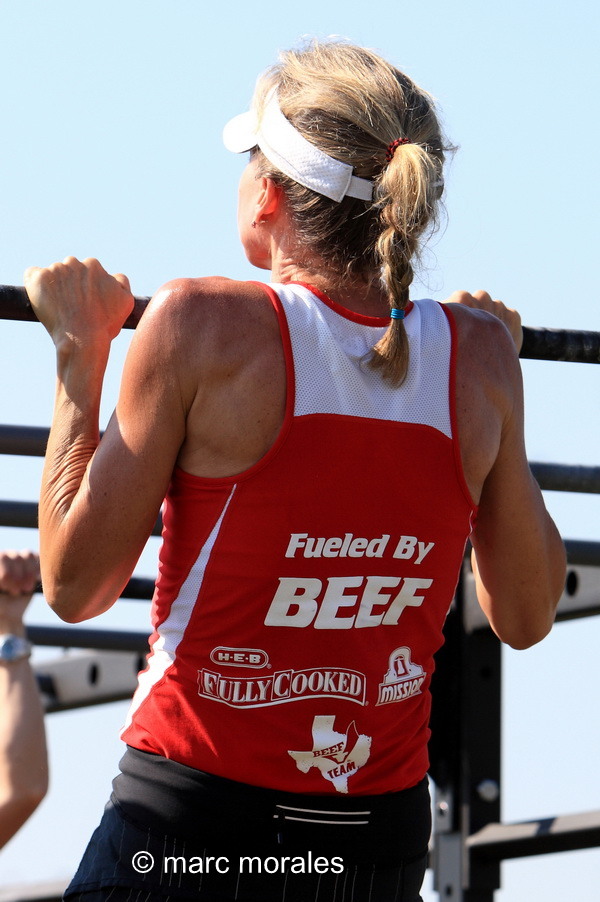
My recent experience at the 2012 Austin Fit Magazine Fittest was filled with quite a few events outside my comfort zone. One of the most intimidating of all was the pull up test that required us girls to perform this classic upper-body strength move just like the guys. No easier chin-ups (where fingertips are oriented on the bar to your face), no swinging, jumping, kipping, butt-wiggling or knee-pumping.   These pull-ups had to be strict, military-style pull-ups where the body must fully-extend back downward into a “dead hang.”  How could I ever make this happen? Never had I EVER even passed the flexed-arm hang test for the Presidential Fitness Test in elementary school. Ugh!

In January at CrossFit Endurance Camp, I could only do one strict pull-up and a couple with a kip. It was embarrassing to be around so many strong women, but a least I had them on the run! Not fully committed to the idea, I started practicing pull-ups chin-up style with a kip (maybe) once a week working my way up to four or five using major swinging motion to get my chin over the bar. Not long later, I could do four or five without the kip. On competition day, an adrenaline rush helped me squeak out six military dead-hang pull-ups and the judge noted I had “good form.”  Whoo-hoo! Inspired by the winner in my age-group who completed 15, I started working a little harder on the dead hang pull-up. Now less than a month later I can do 9!

If I can do “proper” pull-ups (palms facing away from you, no extraneous body movement), so can you! Here are some tips to get you started.

Practice: Do a pull-up progression 3x per week.  Start with 5 sets of 1 or 2 and then work your way up to 3 sets of a few less than your maximum effort.

Negatives: If you are unable to complete a strict pull-up, work on “negatives” first. Negatives are done by jumping up to the bar from the ground, box or half stability ball or with a spotter boost. Once your chin clears the bar, slowly move into the fully-extended dead hang position. Repeat!

Machine-Assisted Pull-Ups: This piece of gym equipment isn’t as intimidating as it looks. Set the counter-weight an amount that offers you an attainable challenge. Kneel on the platform, grasp the overhead bar and pull up!

Supplemental Exercises: Lat Pull-Downs, Ring Rows, Ring Dips, Bicep Curls, Dumbbell Rows

Who Cares About Getting Older With Legs Like These?

For those us getting older (and really who isn’t?), the importance of regular physical exercise is important in so many ways – keeping obesity, heart disease, diabetes, high blood pressure and other chronic problems away. Running, biking, swimming and other physical activities have also been proven to maintain muscle mass and strength, according to a recent study conducted at the University of Pittsburg.

Most of us have fearfully read in fitness magazines that the loss of more and more muscle is inevitable with each passing year. In fact, past studies report that in the decade between 40 and 50 years, a person loses 8 percent of muscle mass – and each future decade results in an even greater percentage loss. Now, this has always made me wonder if I will just be some big blob of fat and bone by the time I’m 70 or 80 or older.  I want to be a strong, healthy older person, not some frail lady with strength, balance and mobility issues that stem from barely-there muscle mass.

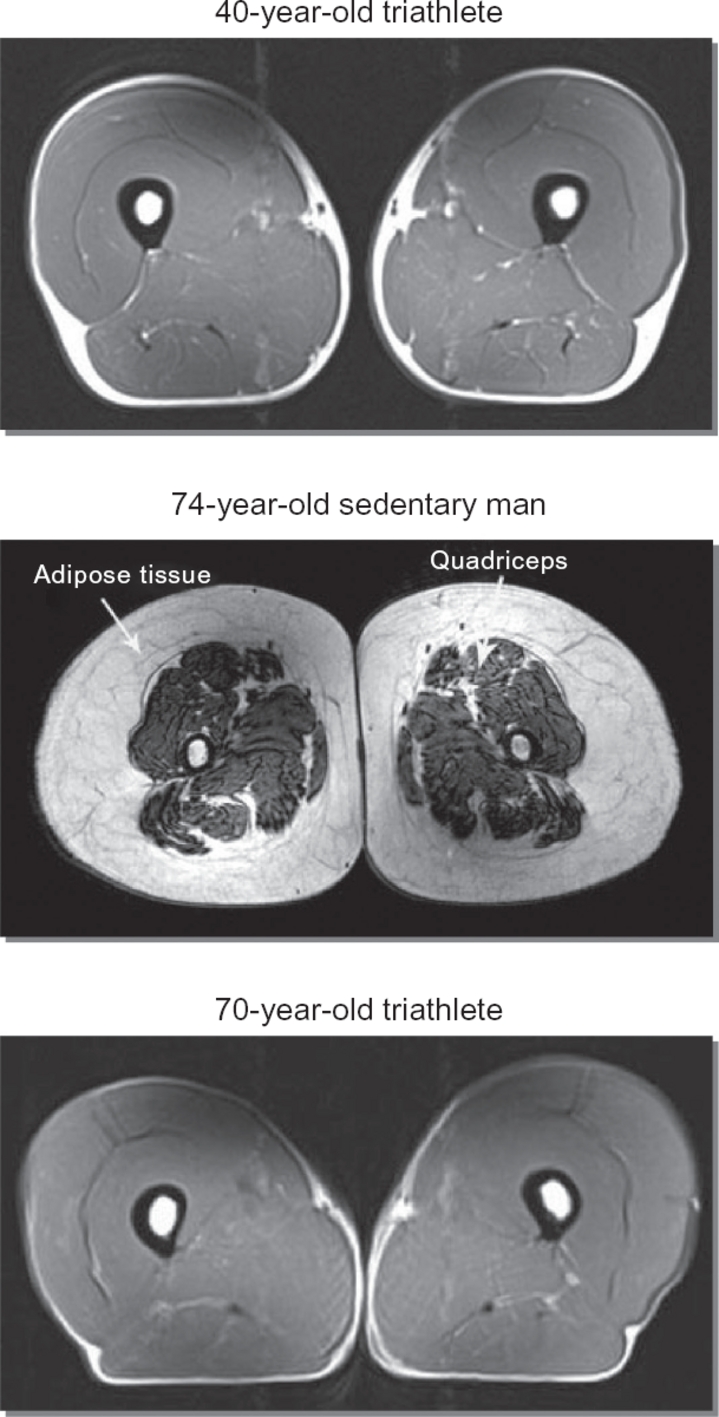
Strong legs at any age thanks to vigorous exercise.

The good news is that this investigation, headed by Vonda Wright, MD (an orthopedic doctor), looked at physically active adults for their research, not the sedentary adults that make up the research groups of most past studies.  The levels of both subcutaneous and intramuscular adipose tissue (that’s fat y’all) were quantified via magnetic imaging in the legs of 40 high-level recreational athletes between the ages of 40 and 81 years, fairly serious athletes who worked out 4 to 5 times per week. The results are readily apparent in these cross-section photos of the quadriceps area (see photos). There is virtually no difference between the 40 year old triathlete and the 70 year old triathlete – in fact, it looks like the young guy has just a touch more subcutaneous fat (gasp).

Personally, I enjoy a juicy, fat-marbled steak — but on my dinner plate, not my legs! You have to agree these photos are instant motivation to get out there and run, walk, bike, swim, climb a mountain or whatever makes you active!

Check out the full white paper on this study at Physician and Sportsmedicine: Volume: 39 No.3

Running For Team ‘After Nuun Delight’!

after nuun delight team runnning Hood To Coast Relay HTCRIt’s been a crazy few weeks in my running life, from my ‘Big Boston Marathon Meltdown’ on April 16thto a jubilant redemption 12 days later with an older-age P.R. in a local 5k (18:44).   Between the highs and the lows, I’ve scarcely had time to report about some exciting news that is unfolding to become the biggest adventure of my year . . . maybe my decade. Drumroll please . . .  I will be joining the exclusive all-female blogger Team Nuun to run the famous Hood to Coast Relay at the end of August 2012. As the largest (not to be confused with ‘longest’) relay race in the world, the 31st running of the Hood to Coast Relay begins in Mount Hood, Oregon and travels all the way down to Seaside – 199 miles!  Not to worry, I won’t be running almost two hundred miles alone, I’ll have 11 other runners that I will share legs with – literally and figuratively!  Our official team name is going to be “After Nuun Delight” – cute, huh?!

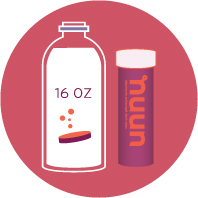
How to use Nuun Hydration.

Nuun tablets are easy to use on the go.,

So if you are new to Nuun, let me give you the skinny on the important product details. Nuun is a hydration tablet that is dropped into 16-ounces of water where it fizzes up Alka-Seltzer style – oh, but it tastes so much better!  Available in 11+ refreshing flavors (I like Strawberry Lemonade and Lemon Tea), Nuun has absolutely no sugar and less than 8 calories per serving – yet doesn’t sacrifice important electrolytes needed to power through a marathon, bike race or other active endeavor. And, if your biggest workout is bar hopping, it’s rumored that a Nuun tablet dissolved in water and consumed before bed and another upon awakening will lessen the effects of a hangover. I wouldn’t know, but I’ve heard.

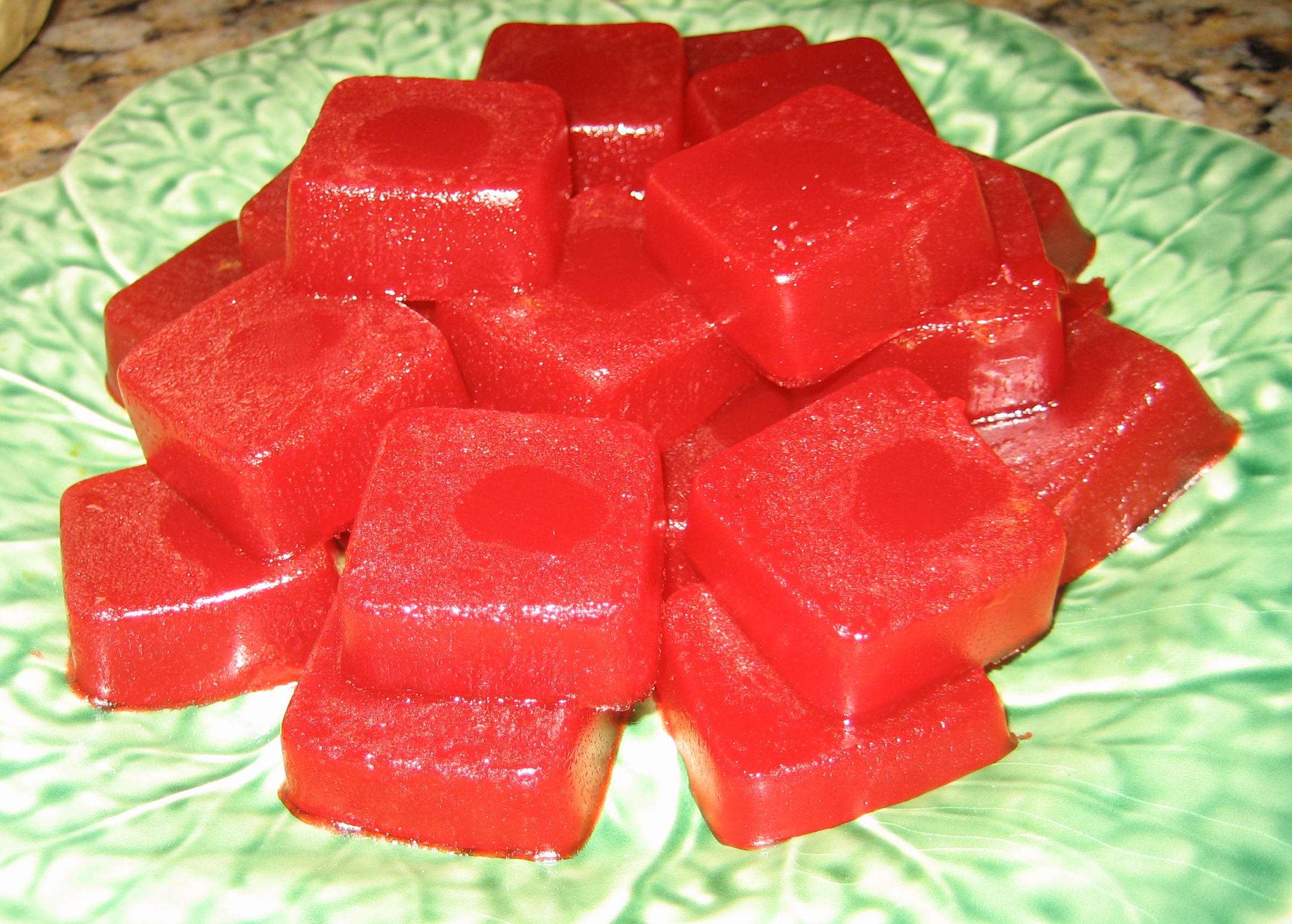
Oh, Yes I Did! Nuun Tri-Berry Electrolyte Jellies

Nuun recipe perfect for Hood To Cost Relay - Team After Nuun Delight

Nuun electrolyte jellies are both a novel and nutritious recipe.

A Jell-O dish of some sorts has long been on the menu at our Easter gatherings, think big 60s style molds suspending little bits of fruit and marshmallow. But, hey, this is 2012 and I need some Jell-O that’s a little more ‘on-the-go’ friendly and addresses my electrolyte needs this week as I finish up training for the Boston Marathon. So hmmm, scratching head . . . why not combine my favorite sports drink tab (Nuun) with a mixture of plain and flavored gelatin to create some mighty-fine, finger-food fuel? Can’t wait for the reaction when I set down this masterful remix of our time-warped gelatin salad tradition on the big Easter buffet.

I’ve been drinking Nuun for years out on my long runs, the subtle yet seriously yummy flavors don’t overwhelm with sweetness – in fact, Nuun tablets are sugar-free with no artificial flavors or colors, providing optimal hydration without all those carbs that sometimes upset my stomach during a race. Now, these jellies do have some sugar in the recipe . . . a girl can’t live by sodium, magnesium and potassium alone!

I have used plain ole table sugar (sucrose) as studies are showing it is really the best best when it comes to endurance and so does this study.  For example, you can’t really ingest enough glucose and metabolize it at a rate fast enough to keep up with your needs in an endurance event and fructose is linked with tummy troubles. So, I’ve just stayed with sugar.  If you want to swap in coconut sugar instead, that will work well too — it’s 80% sucrose and free of fructose.

This recipe uses Nuun Tri-Berry tablets, but after the Boston Marathon, I am going to experiment more with this  recipe and make a ‘sweet victory’ version using Lemon Chai from the Natural Hydration line along with lemon Jell-O and a litt levodka . . . stay tuned for that!

Nuun ‘Tri-Berry’ Electrolyte Jellies
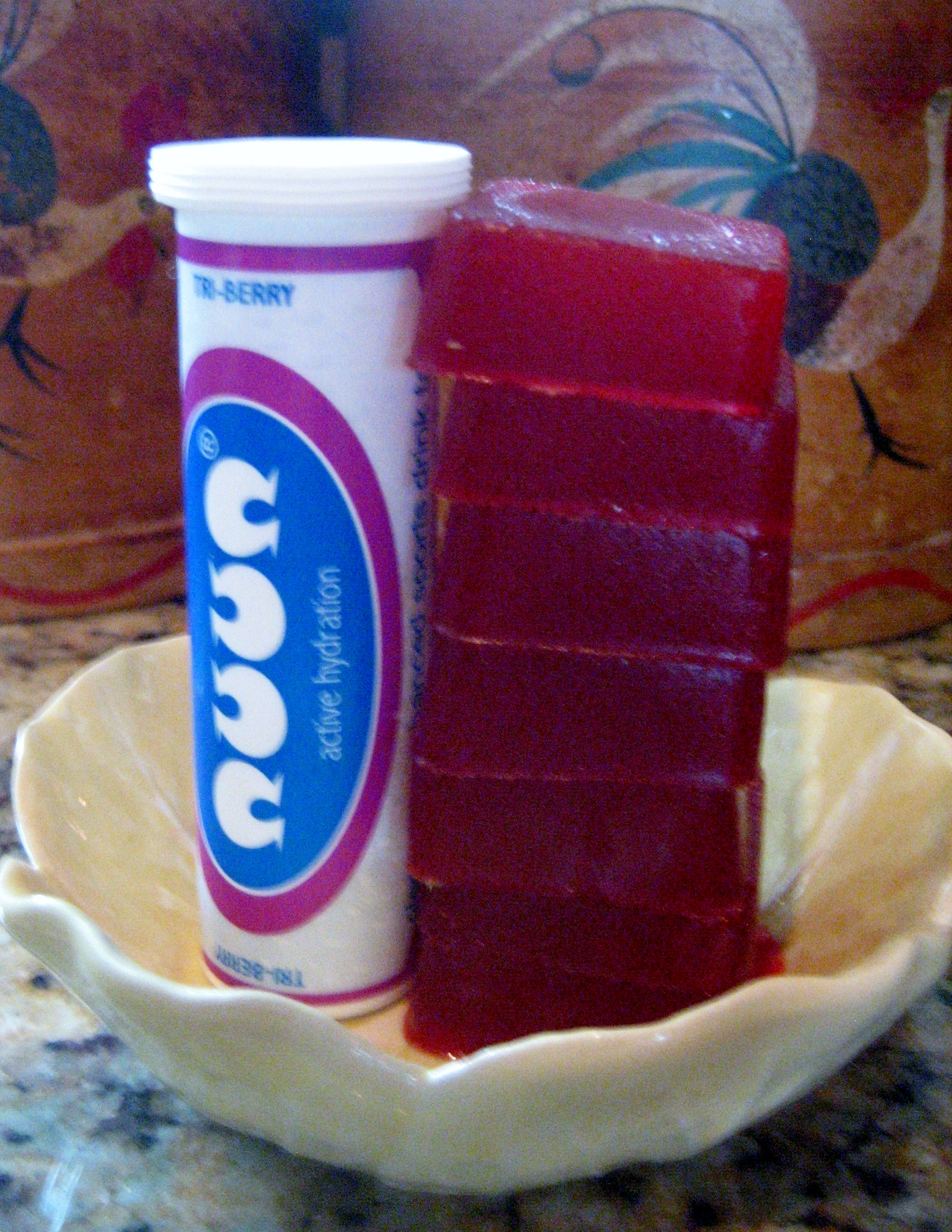
Jello made with Nuun Tri-Berry tablets

• 1 env. (1/4 oz.) unflavored gelatin
• 1¼ cup cold water
• 3 NUUN Tri-Berry sports drink    tablets
• 1/3 cup sugar
• 2 Tbs. cornstarch
• 2 pkg. (3 oz. each) sparkling wildberry flavor gelatin*

Pour cold water into small bowl, drop in Nuun tablets and let dissolve. Sprinkle unflavored gelatin over Nuun-gelatin mixture, let stand 1 min. Mix 1/4 cup sugar and cornstarch in medium saucepan. Gradually whisk in Nuun-gelatin mixture until blended. Bring to boil on medium heat; cook 5 min., stirring constantly. Remove from heat. Add dry gelatin mixes; stir 2 min. until completely dissolved. Pour into 9×5-inch loaf pan** sprayed with cooking spray. Refrigerate 1 hour or until firm. Remove from mold by holding pan upside-down over cutting board, it will slip out. Cut into 24 pieces.

*you can use any mixture of Nuun and flavored gelatin that you prefer
** In lieu of the loaf pan, I used a 24-ct ‘brownie bite’ silicone baking mold.
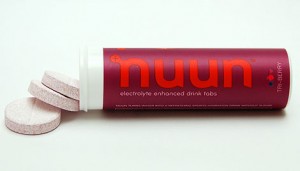
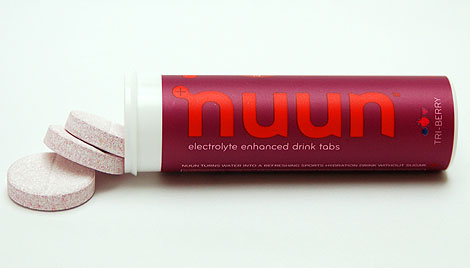
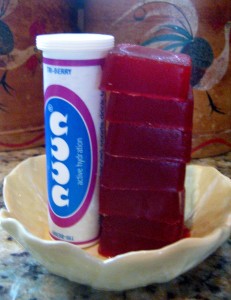
Nuun Tri-Berry Hydration

This is what the current Nuun Tri-Berry container looks like!